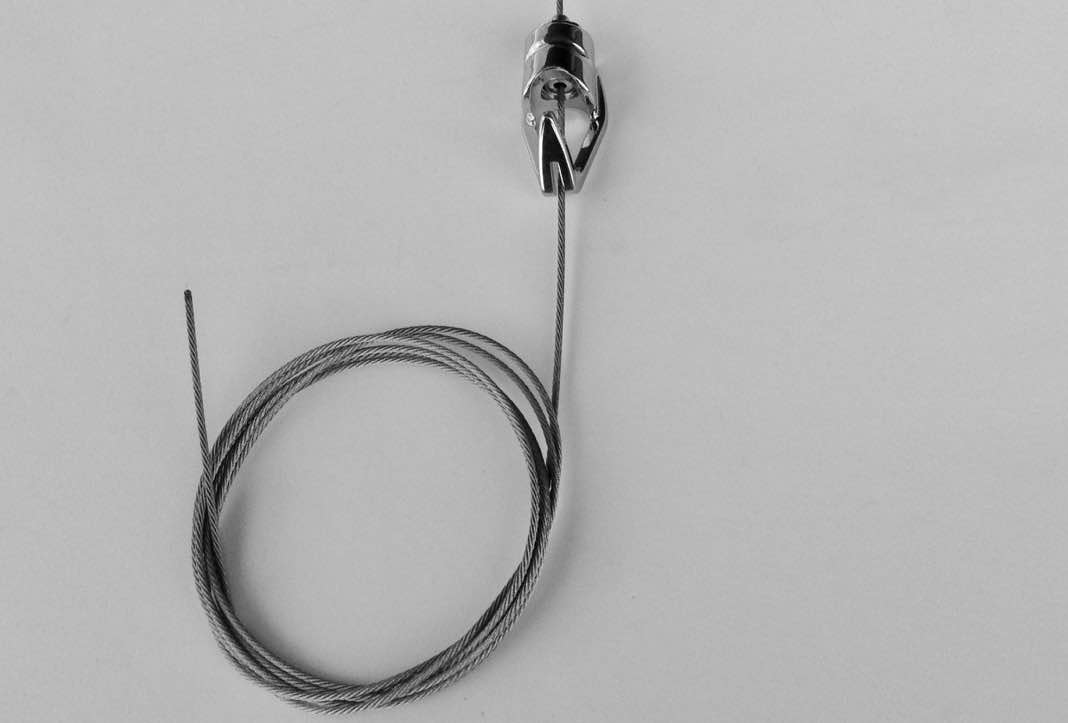
The ‘push button hooks’ for ‘The Gallery System’, the ‘Slimline Art Hanging System’ and our picture rail hangers are the most popular units we sell.They allow the use to adjust the height of the hook without using a tool, which means pieces can be adjusted without being entirely removed; saving a great deal of time especially when making those millimetre perfect adjustments.But exactly what do you need to do use them?
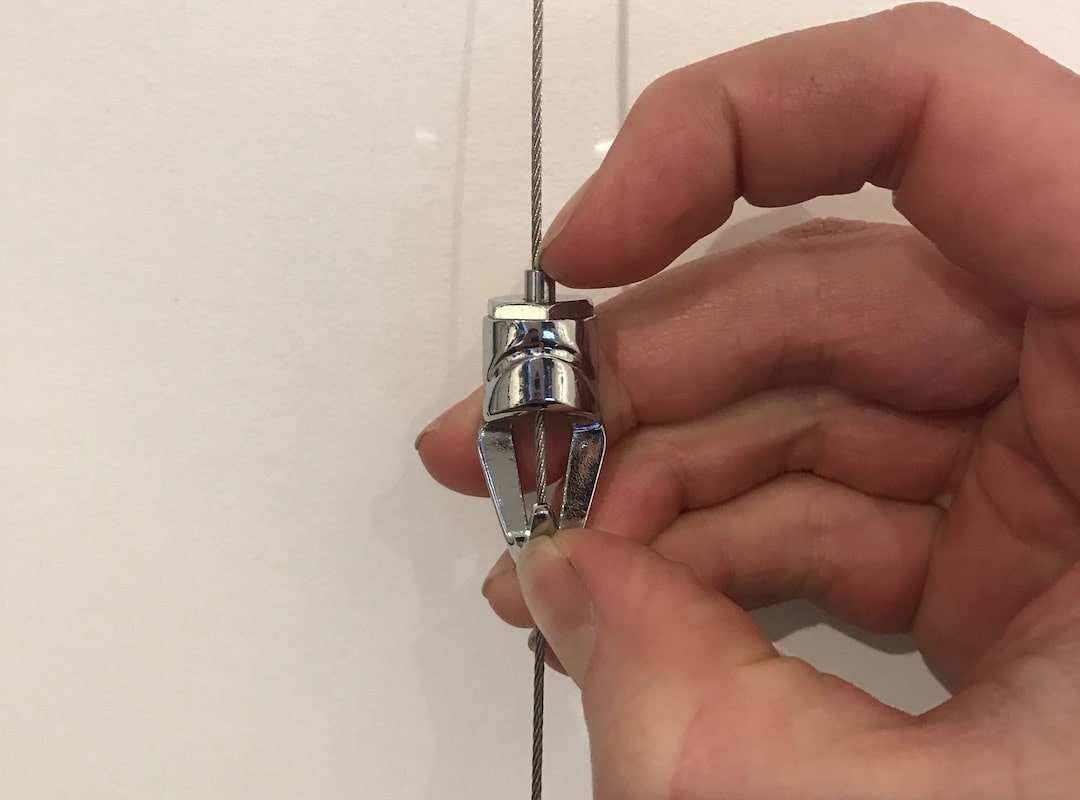
If you inspect the ‘push button hook’ you will note that the wire enters a tube at the top and passes through the centre.This tube also activates the clutch mechanism which releases the hook and allows it to move.As such, adjustment is simply a case of removing the weight from the hook and pressing this tube inward toward the centre and sliding the hook as required.Releasing the tube locks the hook in place.
As you become comfortable with the hook you will not that the hook can be slide up without pressing the tube.As such, it can sometimes be easier to start the hook a little lower and then simply edge the hook up into its desired position.
If you have any questions about any of our picture hanging systems, please don’t hesitate to contact me; call, send me an email or chat online.
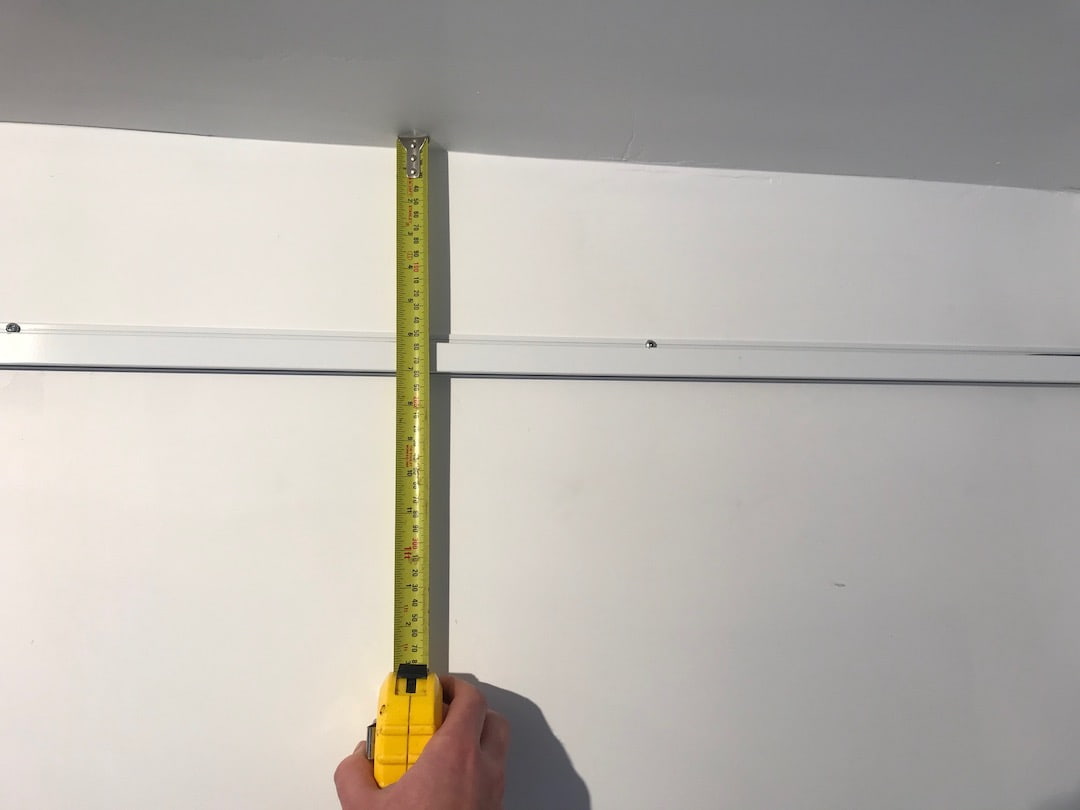
‘The Gallery System’ and the ‘Slimline Art Hanging System’ are wall mount picture hanging systems and we often receive the question, ‘at what height should I place the track (or rails) on wall?’Let me walk you through all the considerations we discuss with clients when helping to make this decision.
In general terms you want to go as high as you can allowing yourself the greatest amount of gallery space possible.However, if you are lucky enough to have very high ceilings, you should firstly check to ensure that droppers are available in the appropriate length to suit and further, you should consider how the end user will add and remove droppers as pieces are changed.It may or may not be appropriate to have staff or loved ones climbing high ladders especially when there may be no benefit to having the track so high – ie when the viewer can only enjoy the pieces from the floor.
The ceiling height is most regularly used as a guide, however, it is very much worth checking all the walls to ensure the cornice or ceiling is in fact straight and true.Even a good ceiling can dip by a few millimetres here and there; we have seen some that dip by as much as an inch (25mm) – not visibly noticeable when going about daily life but very noticeable when a straight edge is placed against it.If you are confident that your cornice or ceiling is straight, then by all means go ahead and use this as a guide or install firmly against it if possible.If it turns out that it is not as straight as perhaps it should be, we highly recommend lowering the track height by 40 to 60mm from the lowest point and using a laser line or straight edge and pencil as a guide.
If super height ceilings are not your problem or you don’t wish to use the ceiling height as a guide for the track, you should consider other visual elements in the room.The traditional Victorian picture rail (for which we carry some great hardware by the way!) was regularly placed inline with the top of the doorways.This and other similar cues, such as windows, might provide a sensible and aesthetically pleasing guide as to an appropriate height for your track.
Should you be installing the system on a masonry or brick wall, it is often best to allow 40 – 60mm of space down from any ceiling or above obstruction to allow room for a rotary hammer drill to do it’s work.These are available in many different sizes but all are typically larger than a standard drill and therefore require some space.
In addition to the above, there are also some system specific requirements that will help you with the decision
If you are intending to, or you may in the future, use ‘The Gallery Lighting System’, then you must be aware that the track should be placed no higher than 2.6m from the floor; unfortunately above this height the effectiveness of the lighting system is diminished.Further, the track must have 20mm of clearance from the top of the track to a cornice, ceiling or anything above to ensure you have room to add and remove the lighting wands as required.
‘The Gallery System’ is fixed to the wall by passing a screw through the top of the track and as such, installing firm against a square set ceiling is an almost impossible task as there is not enough clearance for most power drills (and their chucks).It may be possible where a cornice exists or removable ceiling panels are installed but this will need to be assessed on a case by case basis.
The ‘Slimline Art Hanging System’ uses specially made ‘wall anchors’ which fix to the wall with screws, over which the track is pressed into place (employing an interference fit for the engineers out there).Our wall anchors have been engineered to include two tabs at the top which can be used help vertically align the pieces to a straight edge above such as a cornice or ceiling.This generally will allow enough room for square set ceiling installations to install a screw on an angle, however, a ‘right angle drill attachment’ makes the job a great deal easier, especially if drilling into steal studs.
Many customers will decide on the appropriate height for them once they have the system on hand; this is generally a very reasonably approach.If you have any questions or would like to discuss the height at which you wish to install your track, please don’t hesitate to give us a call.As always we’re delighted to help!
In 1989 the Berlin Wall was still up, ‘Seinfeld’ first aired on television and we began selling ‘The Gallery System’!Since this time there have been a number of hanging systems come and go which has led to problems for people trying to source additional components as new pieces of art come along and fashions change. Naturally, we assist where ever possible in using the existing infrastructure a potential client may have, however, on some occasions, the only option to remove and replace… If only our system had been installed initially!
During this time ‘The Gallery System’ has changed too, with improvements and additions over the years that make the system more usable and generally better than it was in 1989.The improvement, however, has always been done with a commitment to backward compatibility, and because of this our very first customer can still purchase new components to use with their system!
This might seem trivial at the start of your product journey, however, given the investment, I would urge you to do your future self (or a future owner!) a favour and purchase a brand with a track record of availability and compatibility over a long period of time. ‘The Gallery System‘ and ‘Slimline Art Hanging System‘ both deliver on this front!
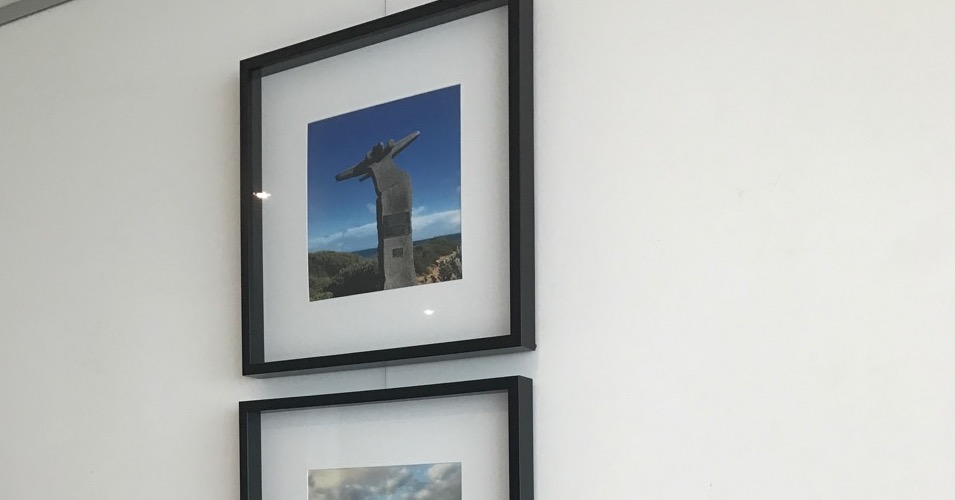
One of the beauties of using a picture hanging system is the ability to hang more than one piece per dropper in a column, however, sometimes getting pieces to sit neatly can be a challenge!Generally the issue occurs because the pieces ‘interfere’ with one another.By that I mean the lower piece will often lean out from the wall and pull the top piece off the wall and cause it to swivel around the dropper.Let me walk you through my approach to overcoming this issue.
(Naturally, before beginning it is important to ensure that the total weight of the pieces to be suspended is with in the weight rating for the dropper.Two droppers can be used if required and the process remains the same.)
Ok, so the first port of call is to use a HangRight Clip on each piece to limit the forward lean as mentioned in the ‘How to Hang Pieces Flat on a Picture Hanging System‘ post.Then, we look at how to ‘push’ the bottom of the pieces from the wall and in doing so allowing a gap for the wire to pass through without hindrance.Sometimes this gap will need to be 12mm before this occurs and whilst this may sound a lot, it does lead to the best outcome possible.
Usually when building up the bottom left and right corners I use our ‘Felt Wall Protectors‘ these are 6mm thick and can be doubled if required to allow for the very minimum of interference from the dropper.
With the top of the frames pulled back and the bottom pushed out your pieces should be sitting beautifully on the wall. 🙂
Have a question or require further information, please contact us to discuss your needs.
Our standard length dropper is 2 metres long. We find that this covers 99% of our clients needs and is suitable for track mounted up to about 3.5 metres high depending on the gallery requirements.
This being said often our clients will not use the entire length of the dropper and may wonder what to do with the left over material.
Firstly, if you are using the stainless steel droppers, what ever you do, DO NOT cut the wire. The stainless steel wire is actually a braid of smaller wires which have been thermally bound at the bottom to prevent unravelling. By cutting the wire you allow the braid to loosen, unravel and eventually cause the early demise of the dropper. Furthermore, cutting the dropper also determines the droppers maximum length in further circumstances.
Instead, we recommend rolling the wire up, folding the end through several times and placing it behind the lowest piece on the dropper; out of the way, safe and sound and ready to be used at longer lengths next time!
When the clear tape droppers are used however, the approach may be slighting different. If the lowest piece suspended on the dropper allows, I would still recommend rolling the tape up and securing it with a zip tie or some sticky tape. This will most likely be possible where the piece has a cavity at the back. If not possible, then it is best to cut the clear tape with a sturdy pair of scissors. When cutting the clear tape, I recommend keeping it as long as possible without having it visible at the bottom of the piece. This way the clear tape still has the greatest adjustment potential when redeployed.
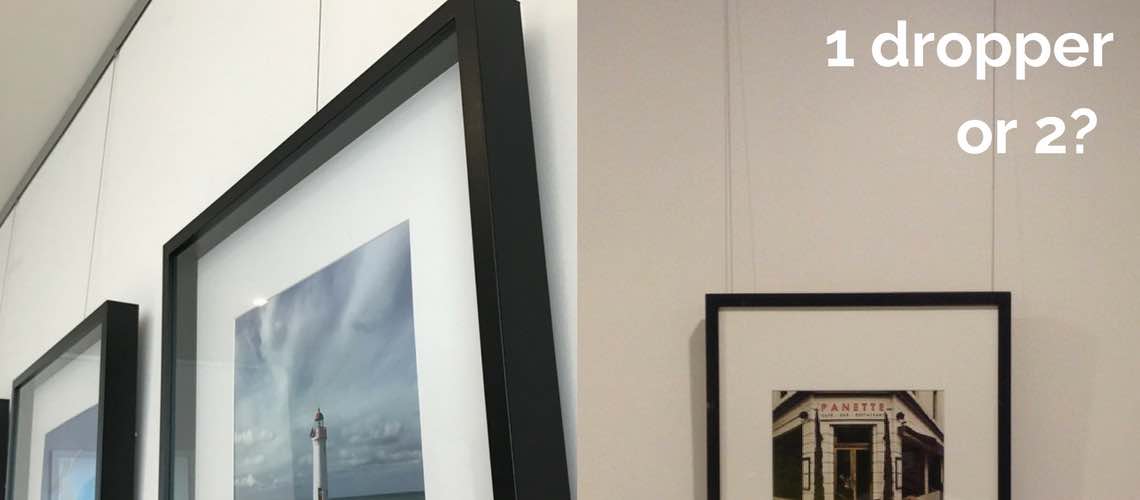
One of the questions regularly asked by potential clients is ‘should I be using 1 dropper or 2 to hang my artwork?’
The honest answer to this question is, ‘it depends…’
Firstly, it is most important to considered the weight specifications of the droppers to be used and the piece to be suspended. Naturally, if you are starting to approach the weight rating specified for the dropper then it is a good idea to use two. This should bring you well inside the specified weight rating and provide a large load margin.
The second consideration is the style of piece. Most balanced portrait pieces will very happily sit on a single dropper without becoming askew. Landscape pieces on the other hand are far more likely to fall out of a level position and often using a second dropper is the best solutions. This is certainly the case in a space which may be exposed to a light breeze.
On that note, thirdly, consider the atmospheric conditions. If your gallery space may be exposed to a breeze, perhaps from a regularly opened door, then it may be worth while using a second dropper per piece to ensure everything remains level and in place – there is nothing more frustrating than having to position all the pieces every time someone enters or leaves the gallery!
Finally, aesthetic considerations. This is a personal choice, in my home, I prefer the minimal look of a single dropper on most of my pieces, however others may prefer the sturdy look of two.
Either way, it is worth considering the above to ensure that your picture hanging system not only performs inline with your expectations but also because different providers will have a different approach which can significantly effect the cost of your system.
Have a question or require further information, please contact us to discuss your needs.
Cheers,
Ed – Shakespeare Solutions.
Short Notes on 1 dropper or 2
Is my piece inside the weight rating of my dropper? No – used two, Yes – one it is!
Will my piece stay balanced? – portrait usually, landscape less easily (but worth trying first).
Is there regularly a breeze in this space which could move the artwork? No – use one, Yes – perhaps use 2
Assuming one can be safely and practically used… do I prefer this look?
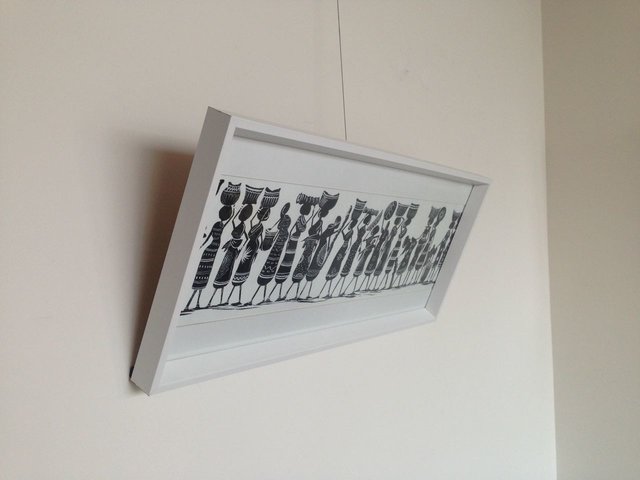
In comparison to a traditional picture hook, picture hanging systems do not offer the same ‘pull’ into the wall and this can sometimes cause pieces to lean further forward than desired. This will effect pieces of different formats, sizes and weight differently. Here is a guide on how to deal tackle this issue.
Firstly, is this actually a problem for you? Put your pieces up and decide whether it is actually a concern. In some circumstances the lean can be quite acceptable and add to the viewing angle of the piece.
However, in other circumstances the effect can be quite pronounce and undesired; I found this to be especially the case in small hall ways were piece on either side cause quite a narrowing effect!
The solution is to lock the top of the piece to the dropper with our HangRight Clips and push the bottom of the piece out from the wall slightly by installing our felt wall protectors. This solution ensures the piece sits as flat on the wall as possible whether using 1 or two droppers to hang. It is also very useful technique when trying to hang multiple pieces in a column but this is a topic for another post!
Hanging Quilts can be a fabulous addition to your home or office and a great way to display the fruits of your labour. However, as you add to and change your collection you will find that hanging different sized quilts from the same wall hooks doesn’t do justice to your creations or the walls on which they hang!
This situation leads to quilts not being hung, those that are hung never moving or your wall resembling swiss cheese with the number of holes created by all the different hooks.
However, it doesn’t have to be this way! Our hanging systems are an inexpensive and flexible way to hang your quilts. Once up you can add new quilts or move existing quilts easily and quickly.
Which system to choose?
Ultimately it depends on whether or not you’d like to add our lighting system to your quilt gallery, however, in the vast majority of circumstances clients hanging quilts have opted to use ‘The Slimline Art Hanging System‘ with clear tape droppers and standard adjustable hooks.
To watch a brief video on our art hanging systems please click on the links below:
For those new to quilting (or the idea of hanging their quilts), preparing your quilts for hanging on your walls is simple; if you have managed to create the quilt you have all the skills required. Please watch this short video outlining how to add loops and dowel to your piece in preparation:
When your quilt is ready to hang it is simple a case of placing two hooks underneath the dowel and rolling any excess dropper behind the quilt. If you have used a dowel or rod that is too large for the hooks we recommend placing some curtain rings around the dowel or rod and hooking these onto the system.
Please contact us if we can assist further, we’d love to help you get your quilts up and onto your walls!
Whilst our standard anodised silver and powder coat white track finishes work in 99% of environments, Shakespeare Solutions can now offer custom finishes to suite any situation.
We have access to the breadth of Dulux Powder Coating colours and would be happy to work with you to find the exact finish you require.
Please contact our team to discuss this option further and to proceed with organising a quote. For more information on our systems please visit Picture Hanging Systems.
Do you have the dilemma of owning a number of pieces of art and being unable to put them on display because you are currently in a rental property and are not permitted to place a hook on the wall?
The answer is not to put the hook in anyway and deal with the problem later but rather to have a open conversation with your landlord / agent about installing a picture hanging system.
In our experience landlords are quite receptive to requests of this nature as it adds future value to the property, saves on costly repairs and reduces the frequency of re-painting.
Furthermore, you’ll have the flexibility to move your pieces around and add to the collection at any point; knowing that you can enjoy your art work in a guilt free fashion.
For the majority of domestic applications we suggest considering the ‘Slimline Art Hanging System‘ as it is unobtrusive and easy to install whilst also very capable in terms of capacity.
Should you require assistance with quoting or working with your landlord / agent please don’t hesitate to contact Shakespeare Solutions via email, telephone or via our online chat box below.
We ship free of charge Australia wide for orders over $35! Our online prices include freight to any Australian address! Thus the price you see, is the price you pay delivered in most cases.
We are very confident that our pricing is sharp! However in the unlikely event that you purchase from us and find the goods cheaper elsewhere, simply call and we’ll refund the difference! (with in 30 days of purchase)
We’ll do anything to make you happy! If you are not 100% happy with products purchased from Shakespeare Solutions simply send them back and we will issue a 100% refund.